
Key Takeaways: The Complete Guide to Cutting Tool Regrinding in 2026
- Centralized regrind programs turn worn cutting tools into strategic assets, extending usable life across multiple cycles at a fraction of new-tool cost.
- Carbide prices have increased dramatically in 2026, making structured regrinding a financial imperative for production teams controlling tooling budgets.
- A proper regrind restores original geometry, edge prep, and coating, delivering near-new cutting performance when executed with precision grinding equipment.
- TE+ connects regional regrinding specialists through one national platform, helping manufacturers reduce total cost of ownership by up to 30%.
- Tool life extension depends on matching regrind frequency to wear patterns, substrate condition, and application-specific variables like material hardness and coolant access.
What Is Cutting Tool Regrinding and Why Does It Matter in 2026?
On most production floors, worn cutting tools get tossed into scrap bins long before they have exhausted their usable life. The assumption is simple: a dull tool is a dead tool. In practice, a solid carbide end mill or drill retains most of its substrate value after the cutting edges wear down. The carbide is still there. The geometry can be restored.
Cutting tool regrinding is a controlled engineering process that restores worn cutting edges to their original geometry and performance specifications. It is not sharpening in a bench grinder sense. A precision regrind addresses flute form, relief angles, edge preparation, point geometry, and coolant-through features using CNC grinding equipment calibrated to the tool's original manufacturing tolerances.
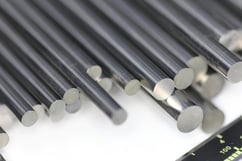 In 2026, the economics of tooling have shifted. According to a ZOLLER analysis published in August 2026, uncoated carbide rod prices increased from approximately 30 euros per kilogram in October 2025 to between 200 and 240 euros per kilogram by May 2026. That represents an 800% increase in seven months, driven by China restricting tungsten exports. Every solid carbide tool in your crib now carries substantially more raw material value than it did a year ago.
This shift turns regrinding from a cost-reduction option into a production strategy. A well-executed regrind typically costs 30 to 40% of a new tool while delivering 85 to 95% of original cutting performance.
How Centralized Regrind Programs Differ from Ad-Hoc Sharpening
Sending a handful of worn end mills to the nearest sharpening shop is not a regrind program. The distinction matters because the results are fundamentally different.
Ad-hoc sharpening addresses individual tools in isolation. The geometry gets approximated rather than restored to specification. Edge prep varies from one regrind to the next. Coatings may or may not be stripped before grinding, leading to layer buildup that creates inconsistent performance. The tool comes back and may cut, but cycle times drift, surface finishes degrade, and operators lose confidence in the tooling.
 A centralized regrind program operates differently. It establishes a repeatable workflow: tool collection, incoming inspection, engineering assessment, precision grinding to original specifications, edge preparation, recoating with the appropriate PVD treatment, quality inspection, and return logistics. Each step follows documented procedures. The output is a tool that performs like its new equivalent because it was restored using the same grinding strategies and inspection standards applied during original manufacturing.
For production teams running multiple shifts across several CNC cells, this distinction shows up in process stability. When reground tools behave predictably, you can plan tool changes around production schedules rather than reacting to unexpected failures.
The Cost Drivers Behind Cutting Tool Spend
Before building a regrind strategy, it helps to understand where tooling cost actually accumulates. The purchase price of a new tool is the most visible number, but it rarely tells the full story.
Raw Material Cost
Tungsten carbide is the primary substrate for high-performance round tools. With tungsten prices at historic highs and limited recycling capacity (the European Commission reported a 42% recycling rate for tungsten in 2023), new-tool prices reflect both raw material scarcity and manufacturing energy costs. Every tool you regrind instead of replace sidesteps that material cost entirely.
Downtime from Unplanned Tool Changes
A tool that fails mid-cycle does not just cost one replacement insert or end mill. It costs the time to stop the machine, inspect the workpiece, verify dimensions, change the tool, re-qualify the offset, and resume cutting. In a high-mix production cell, that sequence can consume 15 to 30 minutes of spindle time per event.
Inventory Carrying Cost
Stocking enough new tools to cover consumption across all active jobs ties up capital. A structured regrind program reduces the number of new tools required because reground tools re-enter the tooling loop on a predictable schedule. Your safety stock requirements shrink when the supply chain includes a reliable reconditioning stream.
Quality Escapes from Inconsistent Tooling
Worn tools produce dimensional drift, burrs, and poor surface finish. Those quality issues cascade into rework, scrap, and inspection labor. A reground tool that matches its original geometry eliminates this drift at the source.
Which Cutting Tools Are Candidates for Regrinding?
Not every worn tool should be reground. The decision depends on substrate condition, remaining length, and whether the geometry can be fully restored without compromising the tool's structural integrity.
Strong Candidates
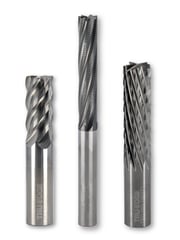 Solid carbide end mills, drills, reamers, taps, step drills, countersinks, and gun drills are all excellent regrind candidates. These tools carry high material value and can typically be reground multiple times before the flute length or overall length becomes too short for the application. Form tools and multi-function tools engineered for specific operations also respond well to precision regrinding when the original geometry is documented.
Conditional Candidates
Coolant-fed carbide tools can be reground if the coolant channels remain intact after material removal. Carbide-tipped tools require assessment of the brazed joint integrity before grinding. HSS and cobalt HSS tools are lower cost individually but may still justify regrinding in high-volume applications where the geometry is complex or the lead time for new tools is long.
When to Retire Instead
Tools with chipped substrates that extend below the cutting edge, cracked shanks, or insufficient remaining length for the required reach should be retired to carbide recycling rather than reground. Grinding a compromised substrate creates a tool that may fail catastrophically under load.
How a Structured Regrind Workflow Operates Step by Step
A production-grade regrind program follows a defined sequence. Each step builds on the previous one to deliver consistent results across every tool that enters the system.
Step 1: Collection and Logistics
Worn tools are collected at the machine shop or tool crib in dedicated regrind containers. Collection frequency aligns with consumption rates, whether that means weekly pickups for high-volume cells or monthly batches for lower-throughput operations. Labeling identifies tool type, application, and customer item number for traceability.
Step 2: Receiving, Sorting, and Cataloging
Incoming tools are sorted by geometry type, substrate material, and condition. New geometries that have not been processed before are flagged for engineering review. This step prevents tools from being routed to the wrong grinding program.
Step 3: Inspection and Assessment
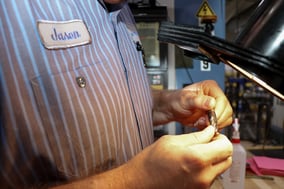 Each tool undergoes inspection to determine regrind eligibility. Technicians evaluate remaining length, substrate damage, flute condition, and whether the tool's geometry can be fully restored. Tools that have reached true end-of-life are routed to recycling. You only pay to regrind tools with genuine remaining value.
Step 4: Engineering and Programming
For tools with documented OEM geometry, the grinding program is loaded from existing specifications. For undocumented or custom tools, engineering teams create grinding programs by measuring the original geometry and developing a restoration strategy that preserves critical dimensions: helix angle, flute depth, core thickness, relief angles, margin width, corner radius, and edge prep specifications.
Step 5: Precision CNC Grinding
Tools are ground on multi-axis CNC grinding machines calibrated to restore original geometry. The grinding process addresses all functional surfaces: primary and secondary relief, flute form, end geometry, step transitions, and chamfers. Grinding parameters are controlled to prevent thermal damage to the substrate.
Step 6: De-coating and Recoating
Before recoating, the previous coating layer is stripped to prevent layer buildup that degrades performance. The appropriate PVD coating is then applied based on the tool's application. The coating selection matches the original specification, whether that is TiAlN for general high-temperature applications, AlCrN for abrasive materials, or nanocomposite coatings for demanding aerospace alloys.
Step 7: Quality Inspection and Documentation
Reground tools are inspected against the same dimensional and geometric specifications applied to new-tool production. Optical comparators, tool-inspection vision systems, and laser micrometers verify critical dimensions. Inspection reports and batch traceability documentation are generated for customers who require them for quality management systems.
Step 8: Packaging and Return
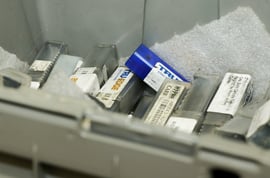 Finished tools are packaged, labeled with item numbers and regrind cycle count, and returned ready for immediate reinsertion into the tool life management system. The turnaround schedule is predictable so production planners can account for reground tools in their inventory planning.
What Determines How Many Times a Tool Can Be Reground?
The number of regrind cycles a tool supports depends on several interacting variables. Understanding these factors helps you plan regrind frequency and forecast when tools will need replacement.
Available Flute Length
Each regrind removes a small amount of material from the cutting end. For drills, this shortens overall length. For end mills, it may reduce both length and diameter depending on the wear pattern. The tool remains viable for regrinding as long as sufficient flute length exists for the required depth of cut in production.
Original Tool Design
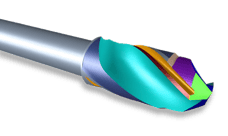 Tools engineered with regrinding in mind can support more regrind cycles. At TE+, custom tools are designed from the outset to allow the maximum number of regrinds by considering how material removal during regrinding will affect critical geometry relationships. This design-for-regrind philosophy is one reason custom tools often deliver lower total cost of ownership than catalog alternatives.
Substrate Integrity
Micro-cracks, thermal damage from aggressive cutting parameters, or edge chipping that extends deep into the substrate can reduce the number of safe regrind cycles. Proper cutting parameters during production protect the substrate and preserve regrind potential.
Application Tolerance Requirements
Tight-tolerance applications, such as aerospace borehole finishing or medical implant machining, may require tools closer to nominal dimensions. These applications may support fewer regrind cycles than general roughing operations where dimensional tolerance is more forgiving.
How PVD Coating Integrates with the Regrind Cycle
Coating is not an afterthought in a regrind program. It is an integral step that determines whether the reground tool will perform at its original level or deliver a degraded result.
The critical sequence is: strip the old coating, regrind the geometry, then reapply the correct coating. Skipping the de-coating step and grinding through existing coating layers creates uneven surfaces that compromise adhesion on the next coating cycle. Over-coating without stripping builds up layer thickness that changes edge geometry and increases the risk of coating delamination during cutting.
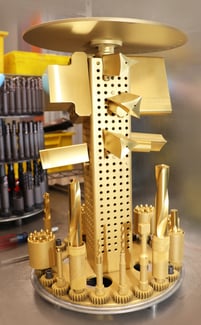 TE+ operates in-house PVD coating vessels, which means regrinding and recoating happen under one roof without shipping tools to a separate coating facility. This reduces turnaround time and ensures the coating selection is matched to the tool's specific application rather than defaulting to a generic treatment.
For example, a solid carbide end mill machining titanium aerospace components would receive a nanocomposite coating like nACo with high nanohardness and oxidation resistance. A drill running production cycles in 4140 steel might receive an ALL4 quad coating optimized for heat resistance across a broader material range. Matching the coating to the application is what separates a precision regrind from a basic sharpen-and-ship operation.
Calculating the Total Cost of Ownership for Reground Tools
The financial case for regrinding becomes clear when you calculate total cost of ownership (TCO) rather than comparing purchase price alone.
TCO Formula for a Regrind Program
TCO per tool life cycle = (New tool cost + Regrind cost per cycle x Number of regrind cycles) divided by (Total parts produced across all cycles). This gives you cost per part rather than cost per tool, which is the metric that actually connects to production budgets.
Example Calculation
Consider a solid carbide end mill that costs $180 new. A precision regrind with recoating costs $55 per cycle. The tool supports three regrind cycles before retirement. In production, the new tool machines 500 parts before reaching its wear limit, and each reground version machines 450 parts (90% of new-tool life).
Without regrinding: $180 / 500 parts = $0.36 per part in tool cost.
With regrinding: ($180 + $55 x 3) / (500 + 450 + 450 + 450) parts = $345 / 1,850 parts = $0.19 per part in tool cost.
That represents a 47% reduction in tooling cost per part. Scale that across hundreds of tools consumed per month in a production facility, and the annual savings become substantial.
How TE+ Delivers Centralized Regrind Programs Across Regions
Manufacturing operations rarely sit in one location. A plant in Ohio may run different operations than a facility in the Northeast or Southwest, yet both consume cutting tools that need reconditioning on a predictable schedule.
That is where TE+ fits. TE+ brings together regional centers of excellence, including Tru-Edge in the Midwest and South, ASG (American Specialty Grinding) in the Northeast, and PTG (Premier Tool Grinding) in the Southwest, under one national tooling platform. Each regional center maintains the engineering staff, CNC grinding equipment, and in-house PVD coating capabilities required for precision regrinding. The national coordination layer ensures consistent quality standards, shared engineering knowledge, and unified logistics regardless of which facility processes your tools.

This structure means you keep working with local experts who understand your production environment while gaining access to broader capabilities and faster coverage. The goal is simple: help manufacturers get more value from every tool without adding vendor complexity to an already complicated supply chain.
Designing Tools for Maximum Regrind Cycles
The best regrind outcomes start before the tool ever touches a workpiece. Tool design decisions made during engineering directly affect how many times a tool can be successfully reground and how much performance is retained across each cycle.
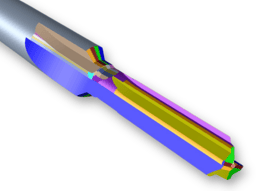 At TE+, custom round tools are engineered with regrinding built into the design intent. This means considering flute length allowances, how step transitions will be maintained after material removal, whether coolant channel geometry remains functional as the tool shortens, and how edge prep specifications will be restored during each regrind cycle.
A tool engineered for a defined role with regrind cycles planned from the beginning can deliver four, five, or more lives before retirement. A catalog tool adapted to an application may support only one or two regrinds before critical geometry relationships degrade beyond acceptable limits. Over a production run of thousands of parts, that difference compounds into significant cost-per-part advantages.
Common Mistakes That Reduce Regrind Quality and Tool Life
Not all regrind operations produce equal results. Several common practices undermine the quality and performance of reground tools.
 Grinding Without De-coating
Leaving old coating in place before grinding creates an uneven substrate surface. The new coating adheres poorly to areas where old coating residue remains, leading to early delamination, inconsistent edge geometry, and unpredictable tool life.
Approximating Geometry Instead of Restoring to Specification
Matching a geometry "close enough" by visual comparison rather than grinding to documented specifications produces tools with inconsistent helix angles, incorrect relief, and imprecise edge prep. These tools may cut, but they introduce dimensional variation and reduce process stability.
Ignoring Thermal Damage During Grinding
Aggressive grinding parameters that generate excessive heat can create micro-cracks in the carbide substrate. These cracks may not be visible during inspection but will propagate under cutting loads, causing premature failure during production.
Skipping Inspection
Returning reground tools without verifying critical dimensions against specification creates uncertainty in the tooling system. Operators lose confidence in reground tools, and the production team defaults to using new tools even when regrinds are available.
When Regrinding Should Not Be Your First Strategy
 This does not mean every worn tool should be reground. There are situations where regrinding is not the correct response to a tooling problem.
If tools are wearing prematurely due to incorrect cutting parameters, material mismatch, or poor chip evacuation, regrinding addresses the symptom rather than the cause. The reground tool will wear just as quickly if the underlying process condition remains unchanged. In these cases, the first step is diagnosing why the tool is wearing and correcting the process before establishing a regrind frequency.
Similarly, if a tool geometry does not match the application requirements, meaning the helix angle, flute count, or edge prep is wrong for the material and operation, regrinding restores a geometry that was never correct in the first place. A custom-engineered tool designed for the specific application may deliver better results than repeatedly regrinding a catalog tool that was always a compromise.
Sustainability and Material Recovery in a Regrind Program
Beyond cost control, centralized regrinding contributes to environmental goals that many manufacturers are now required to report against. Extending the life of carbide tools directly reduces demand for newly mined tungsten, a critical mineral with concentrated supply chains and energy-intensive extraction processes.
Each regrind cycle keeps a tool in productive use without consuming additional raw material. When tools finally reach end-of-life after maximum regrind cycles, the remaining carbide substrate enters recycling programs that recover tungsten for reuse in new tooling production. A structured program creates a documented chain of custody from first use through final recycling.
For manufacturers reporting against ESG targets or responding to OEM supply chain sustainability requirements, a regrind program generates measurable, auditable data: tons of carbide kept in service, number of regrind cycles completed, and volume of material routed to recycling rather than landfill.
How to Evaluate a Regrind Service Before Committing
Not all regrind services deliver the same results. Before committing production tooling to a new provider, evaluate these factors:
Grinding Equipment and Capability
Multi-axis CNC grinders with in-process measurement and automated compensation produce more consistent results than manual or semi-automatic equipment. Ask about machine specifications, process controls, and how the provider handles new geometries that have not been previously programmed.
In-house Coating Capability
Providers with in-house PVD coating eliminate the shipping step between grinding and coating, reduce turnaround time, and maintain tighter process control over the coating selection and application. This is particularly important for tools that require application-specific coatings rather than a generic treatment.
Engineering Depth
A regrind provider with engineering staff can do more than restore geometry. They can analyze wear patterns, recommend parameter adjustments to extend tool life between regrinds, and identify opportunities for custom tool designs that support more regrind cycles. Engineering-led regrind programs deliver value beyond the physical grinding process.
Quality System and Traceability
ISO certification, documented inspection procedures, tool-level traceability, and the ability to generate inspection reports are baseline requirements for production-grade regrinding. Providers serving aerospace and medical applications should hold relevant quality certifications and demonstrate familiarity with the traceability requirements those industries demand.

Logistics and Turnaround
Predictable turnaround times allow production planners to account for reground tools in their scheduling. Ask about typical lead times, capacity constraints, and how the provider handles rush requests when a critical tool needs expedited reconditioning.
Building a Regrind Program from Scratch: A Practical Framework
If your operation does not currently have a structured regrind program, starting one follows a logical sequence.
Audit Current Tooling Consumption
Identify which tools you consume in the highest quantities and at the highest cost. Focus on solid carbide round tools first, as these carry the most raw material value and respond best to precision regrinding. Document tool types, consumption rates, and current cost per part.
Define Regrind Criteria
Establish clear rules for when a tool enters the regrind stream versus retirement. These criteria should address minimum remaining length, maximum wear depth, substrate damage thresholds, and application-specific tolerance requirements.
Select a Regrind Provider
Evaluate providers against the criteria described above. Start with a trial batch of your highest-volume tools and compare reground performance against new-tool baselines in production. Measure tool life, dimensional accuracy, and surface finish to validate the provider's capability.
Establish Collection Logistics
Set up dedicated collection containers at the tool crib or machine area. Define pickup schedules that match consumption rates. Label worn tools with enough information for the regrind provider to route them correctly: tool type, customer item number, and application if relevant.
Track Results and Refine
Monitor cost per part, tool life per regrind cycle, and process stability metrics after implementing the program. Use this data to adjust regrind frequency, identify tools that benefit from custom engineering, and forecast annual tooling budgets more accurately. TE+ offers tool life management programs that include this kind of ongoing performance tracking and optimization.
In Conclusion: How Centralized Regrinding Fits Your Production Strategy
Cutting tool regrinding is not a maintenance task. It is a production strategy that directly affects cost per part, process stability, and material sustainability. In a market where carbide costs have shifted fundamentally, extracting maximum life from every tool is no longer optional for operations serious about cost control.
The right answer depends on your specific applications, materials, volumes, and tolerance requirements. A centralized program built on precision grinding, proper coating integration, and engineering-led design decisions delivers results that ad-hoc sharpening cannot match. For manufacturers looking to reduce total tooling cost while maintaining the cutting performance their processes demand, a structured regrind program is where the conversation starts.
FAQs about Cutting Tool Regrinding in 2026
How much does cutting tool regrinding cost compared to buying new tools?
A precision regrind with recoating typically costs 30 to 40% of a new tool's price. TE+ regrind programs aim to reduce total cost of ownership by up to 30% by maximizing the number of regrind cycles each tool supports across its full service life.
How many times can a solid carbide tool be reground?
Most solid carbide end mills and drills support two to five regrind cycles depending on original design, remaining flute length, and substrate condition. TE+ engineers custom tools with regrind cycles planned from the beginning, which typically supports more cycles than catalog alternatives.
Does a reground tool perform as well as a new tool?
When reground to original specifications and recoated with the correct PVD treatment, a tool delivers 85 to 95% of its original performance. TE+ grinds reconditioning work on the same CNC equipment and to the same quality standards applied during new-tool production.
What types of cutting tools can be reground?
Solid carbide end mills, drills, reamers, taps, step drills, gun drills, countersinks, form tools, and multi-function tools are all candidates. TE+ also handles HSS, cobalt HSS, powdered metal, coolant-fed carbide, and carbide-tipped tooling across its national network of regional centers.
How do I know when a tool should be reground versus replaced?
A tool is a regrind candidate when wear is limited to cutting edges and the substrate remains structurally sound with sufficient remaining length for the application. Tools with deep chips, cracked shanks, or thermal damage below the surface should be retired to carbide recycling rather than reground.
Why is PVD coating important after regrinding?
Regrinding removes the existing coating along with worn material. Without recoating, the exposed carbide substrate wears faster and generates more heat at the cutting edge. TE+ applies in-house PVD coatings matched to each tool's application, ensuring the reground tool performs at its engineered capability.